
-
Event DateNovember 27, 2026 - November 28, 2026
- Leave a review
- Bookmark
- Call now
- Get directions
- Share
- Report
- Claim listing
- prev
- next
Information
-
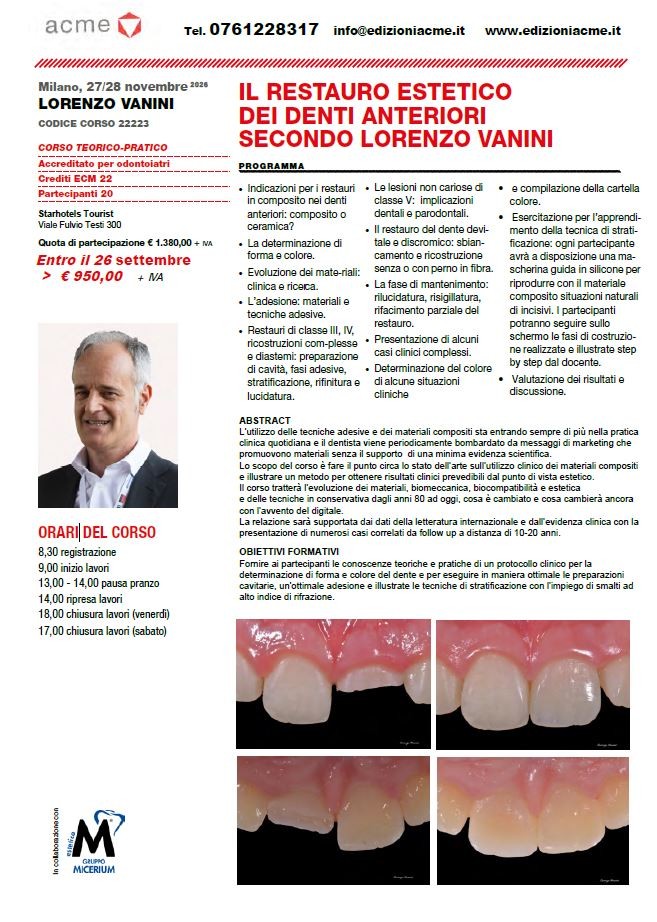
Adhesive conservative restoration of anterior teeth now offers numerous advantages thanks to modern adhesive techniques and composite materials that are increasingly similar to natural enamel and dentin. The course includes a brief introduction about the current indications for the use of composite materials in the restoration of anterior teeth and the presentation of specific clinical protocols for the correct use of these materials in different reconstructive situations.
A new clinical protocol for the determination of shape and color using digital images will be presented; This revolutionary method makes the color phase simple, predictable and reliable, which is the weak point of any reconstructive procedure in aesthetic dentistry. We will talk about cavity preparations, adhesion and stratification with the use of the new enamel with a high refractive index that simplifies the technique making everything easier and with extraordinary results. Surface treatment with finishing, polishing and maintenance steps will close the presentation. In vitro and clinical research show that modern dentistry is based on adhesion, the only way to obtain a valid and durable coronal seal, synonymous with restoration integration and biocompatibility.
The presentation, in addition to the numerous images, will also be supported by videos of clinical cases.
The use of adhesive techniques and composite materials is increasingly entering daily clinical practice and the dentist is periodically bombarded with marketing messages that promote materials without the support of a minimum scientific evidence. The aim of the course is to take stock of the state of the art on the clinical use of composite materials and to illustrate a method to obtain predictable clinical results from an aesthetic point of view. The course will deal with the evolution of materials, biomechanics, biocompatibility and aesthetics and techniques in conservative dentistry from the 80s to today, what has changed and what will still change with the advent of digital. The relationship will be supported by data from the international literature and clinical evidence with the presentation of numerous related cases from follow-up after 10-20 years. All materials will be provided by ACME and Micerium
- Lorenzo Vanini
Details
- Indications for composite restorations in anterior teeth: composite or ceramic?
- Determination of shape and color
- Evolution of materials: research and clinical
- Adhesion: adhesive materials and techniques
- Class III, IV restorations, complex restorations and diastemas: cavity preparation, adhesive phases, layering, finishing and polishing
- Class V non-carious lesions: dental and periodontal implications
- Restoration of the vital and dyschromic tooth: whitening and reconstruction without or with fiber post
- The maintenance phase: repolishing, resealing, partial remaking of the restoration
- Presentation and discussion of some complex cases
- Medium and long-term results
- Summary and discussion of the basic concepts presented in the theoretical part
- Determination of the color of some clinical situations and compilation of the color chart
- Exercise for learning the layering technique: each participant will have a silicone guide mask at their disposal to reproduce natural situations of incisors with the composite material. Participants will be able to follow the construction phases carried out and illustrated step by step by the teacher on the monitor and perform them in turn.
- Evaluation of results and discussion
- 8.30 Registration
- 9.00 a.m. start of work
- 13.00 lunch break
- 14.00 resumption of work
- 18.00 closing of the meeting
Credits: 22 ACCREDITED FOR DENTISTS
€ 1.380,00 + IVA
€ 1.683,60 IVA inclusa
Disponibile
Lunch break
MILANO StarHotels Tourist - viale Fulvio Testi 300
Countdown
-
00
Days -
19
Hours -
52
Minutes
Upcoming Dates
- November 27, 2026 - November 28, 2026 Add to Google Calendar Add to iCalendar Upcoming
Location
-
Milan, Lombardy, Italy
Course Style

Subject

Target Audience
Contact Details
- +39 0761228317
- info@edizioniacme.it



Add a review